Queueing Theory of Traffic
Published on Sat 14 March 2026
When steady traffic limits the speed on a road, we argue that its throughput becomes independent of traffic density. As a result, the time required to reach a destination depends only on the number of cars ahead. In this regime, a road behaves much like a standard queue. We explore several consequences of this perspective.
Constant Throughput
In a prior post, I used dimensional analysis to derive the speed \(v\) of steady road traffic as a function of two inputs: \(\lambda\), the density of cars in units of \([cars / mile]\), and \(T\), the response time of vehicles to sudden stops or other changes (perhaps around one or two seconds). With these inputs, I argued that the speed of traffic must scale as
Plugging in reasonable values for these inputs under light traffic conditions yields a speed of roughly \(70\) mph, which is what we typically observe on highways.
Now consider the throughput of cars passing a fixed point on the road. This is simply the density of cars multiplied by their velocity. Substituting (\ref{1}) for the speed gives
The density has canceled out. This is the key result, and it says that the number of cars that can pass a given point on the road is one every \(T\) seconds\(^1\), independent of \(\lambda\). In this sense then, driving in traffic resembles waiting in a queue: The time it takes you to reach a target destination is simply \(T\) (which is analogous to the queue's service time) times the number of cars ahead of you. Figure 1 illustrates the idea.
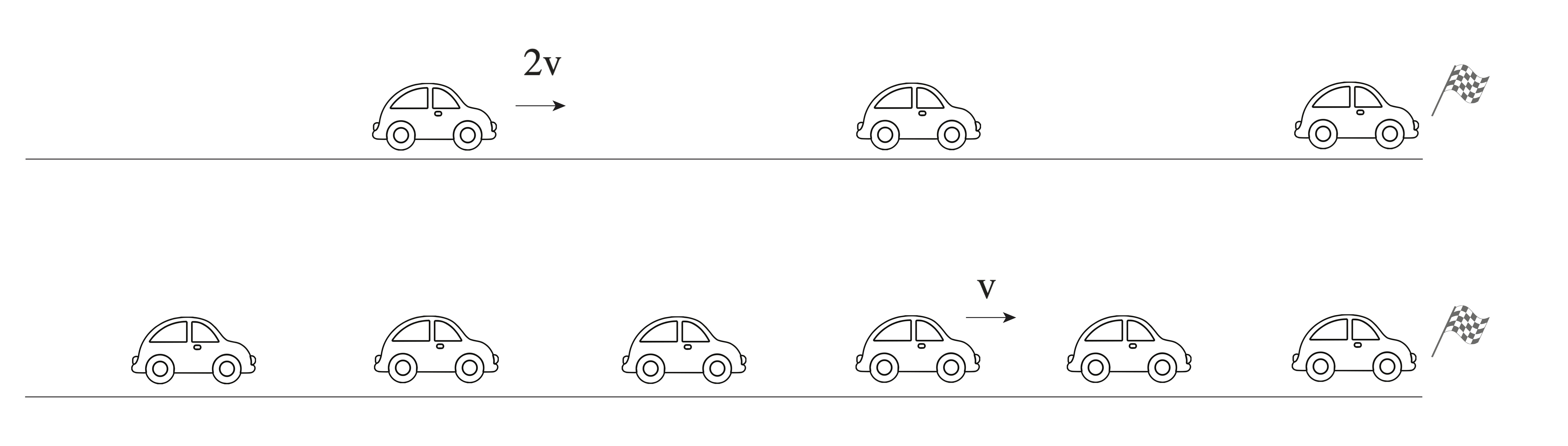
Figure 1. (top) In light traffic, the marked car has two cars ahead of it before the finish line and travels at speed \(2v\). (bottom) The marked car starts closer to the finish line, but traffic is twice as dense and therefore moves at half the speed according to (\ref{1}). It also has two cars ahead of it, and so it reaches the finish line at the same time as the marked car above.
Consequences
Some (perhaps) surprising consequences follow from this queueing view of traffic.
-
It can be tempting to try to drive faster in traffic in an attempt to arrive sooner. But just as it does not help to crowd the person ahead of you in a grocery queue, it also does not help to do so on the road\(^2\). You will reach your exit at the same time either way, so back off!
-
Why do things slow down when there is more traffic? When more cars enter the queue than can exit (as determined by the throughput capacity of the road), the queue grows. This means it takes longer to reach a destination simply because more cars are ahead. The longer this input / output imbalance persists the worse traffic becomes. See my prior post on queues for details.
-
The constant-throughput result breaks down in two limits. First, when traffic is very light, speed is no longer traffic-limited but instead determined by the speed limit or by what feels safe under current conditions. Second, in the opposite limit of very heavy traffic, stop-and-go conditions can emerge. In this regime the throughput can drop. When stuck in traffic, you can estimate this effect by measuring the delay between your car and the one ahead. The ratio of this observed delay to the steady value \(T\) (again, perhaps one or two seconds) indicates how much slower the flow has become due to the jam.
-
Some freeway on-ramps have traffic lights that limit the rate at which cars can enter. A simple example is seen entering the Bay Bridge from the East Bay towards San Francisco. There, a single light restricts how quickly cars can enter the bridge. Often there is heavy traffic at the light while traffic on the bridge itself moves relatively smoothly. The idea is likely the following. If traffic on the bridge can be kept below the stop-and-go threshold, the throughput will be governed by (\ref{2}). In that case, the best possible wait time is achieved: the system behaves like a queue with service time \(T\). But if cars entered too quickly, stop-and-go traffic might form on the bridge, reducing throughput. In either case the number of cars ahead of you is the same, but with the lights regulating entry to ensure steady flow, you should reach San Francisco sooner.
Footnotes
[1] We've derived (\ref{2}) from our prior speed scaling argument, but we can also almost write it down directly. The result is equivalent to assuming that drivers attempt to stay a fixed number of seconds behind the car in front of them. I was instructed to do just this when I took Driver's Ed, and was taught to aim for a two second delay.
[2] Of course, in a multi-lane scenario it is sometimes possible to go faster by actively switching lanes.