Two party systems and the quartile voters
Published on Sun 06 September 2026
We present a minimal model for elections in two-party systems [1]. In this model, elections that have a primary process produce lower average voter utility than do single-stage elections. In the former case, a candidate wins who sits at the first or third quartile on positions, while in the latter the winner sits at the median.
Coffee House Allegory
Initially a single coffee shop (black) sits on Main Street. A second business decides to open a competing coffee shop (orange) and opts to place it so as to maximize revenue – right next to the black shop. See Figures 1a and 1b for explanation. The average walking distance of consumers in this case is
where \(L\) is the length of the street and we assume demand is evenly distributed.
Although 1b is optimal for the retailers, it is not optimal for consumers. To minimize the average distance a consumer must walk, the two shops should be placed at the medians of their respective domains – as in 1c. In this case, the average walking distance is
half that of (\ref{1}). We see that different optimization processes result in different consumer utilities.
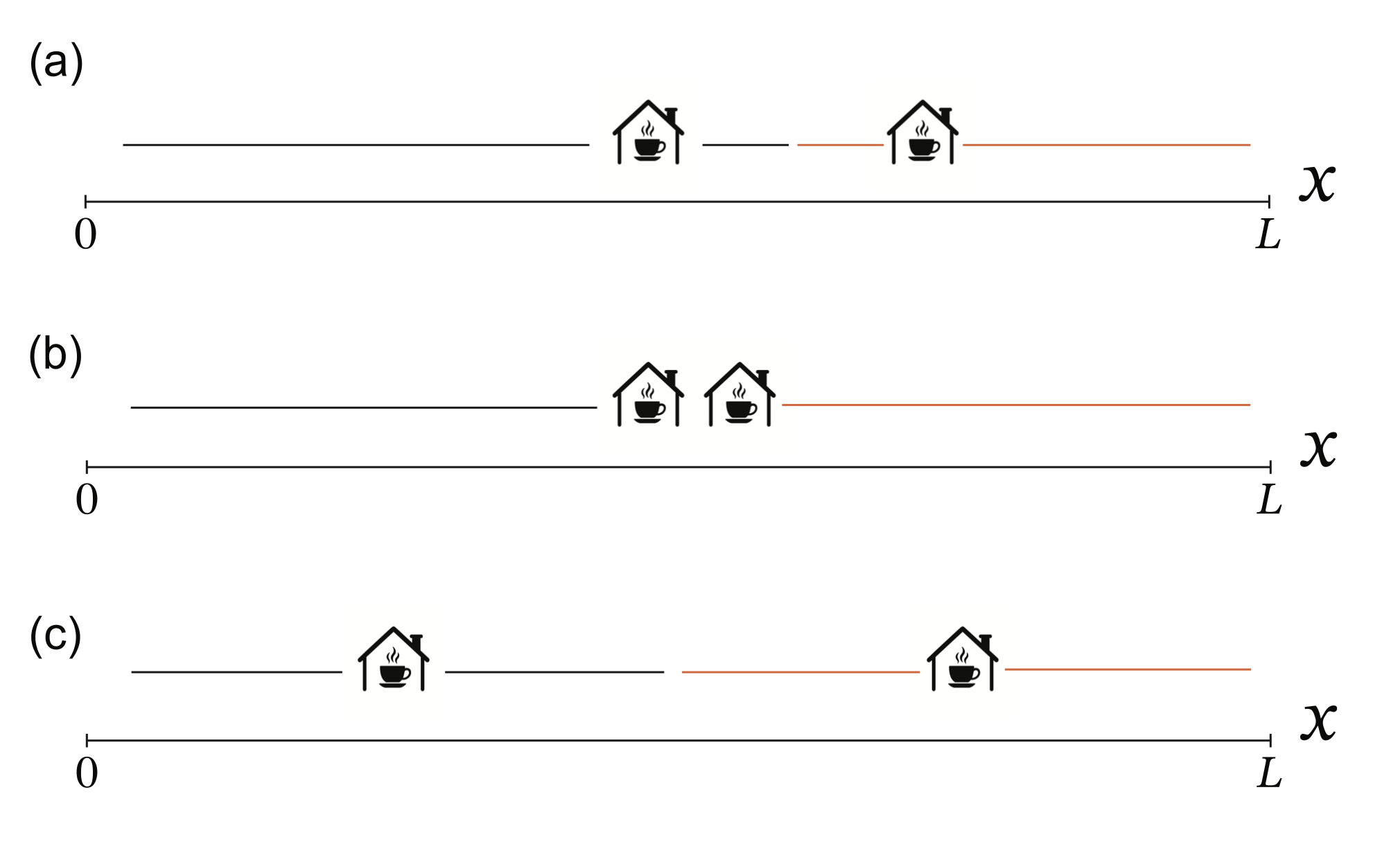
Figure 1: Optimal placement of coffee shops, assuming consumers prefer the shop closest to them. (a) If two coffee shops sit apart, each captures half the demand between them. (b) If the orange shop instead sits next to black, it will capture all of the demand between them in a, rather than just half. (c) Consumers would prefer each shop to sit in the median of its respective domain, halving their average travel time.
General and primary elections
Consider now the positions taken by two political parties on an issue. When a party takes a non-median position, it is costly because the opposition can sit adjacent to them and capture more than 50% of the electorate. For most issues, we therefore expect parties to pursue adjacent positions near the median voter as in Figure 2a.
This is complicated by the primary system which allows voters on either side to first select their candidate. Competition here will push candidates towards the median position of their party as in 2b. This solution is the analog of 1c for coffee shops, favored by consumers. But this is illusory, because just one candidate takes the general election. Ultimately, we end up with 2c or its image.
If we define the voter loss function as the average distance to the elected official, (\ref{1}) and (\ref{2}) give the losses of the median and both quartile cases. The loss of 2c is
worse than either of the other solutions.
Conclusion: Primaries allow voters to pursue the illusory (2), but cause them to end up with (3) – 25% worse than what they'd get under a single-step process (1).
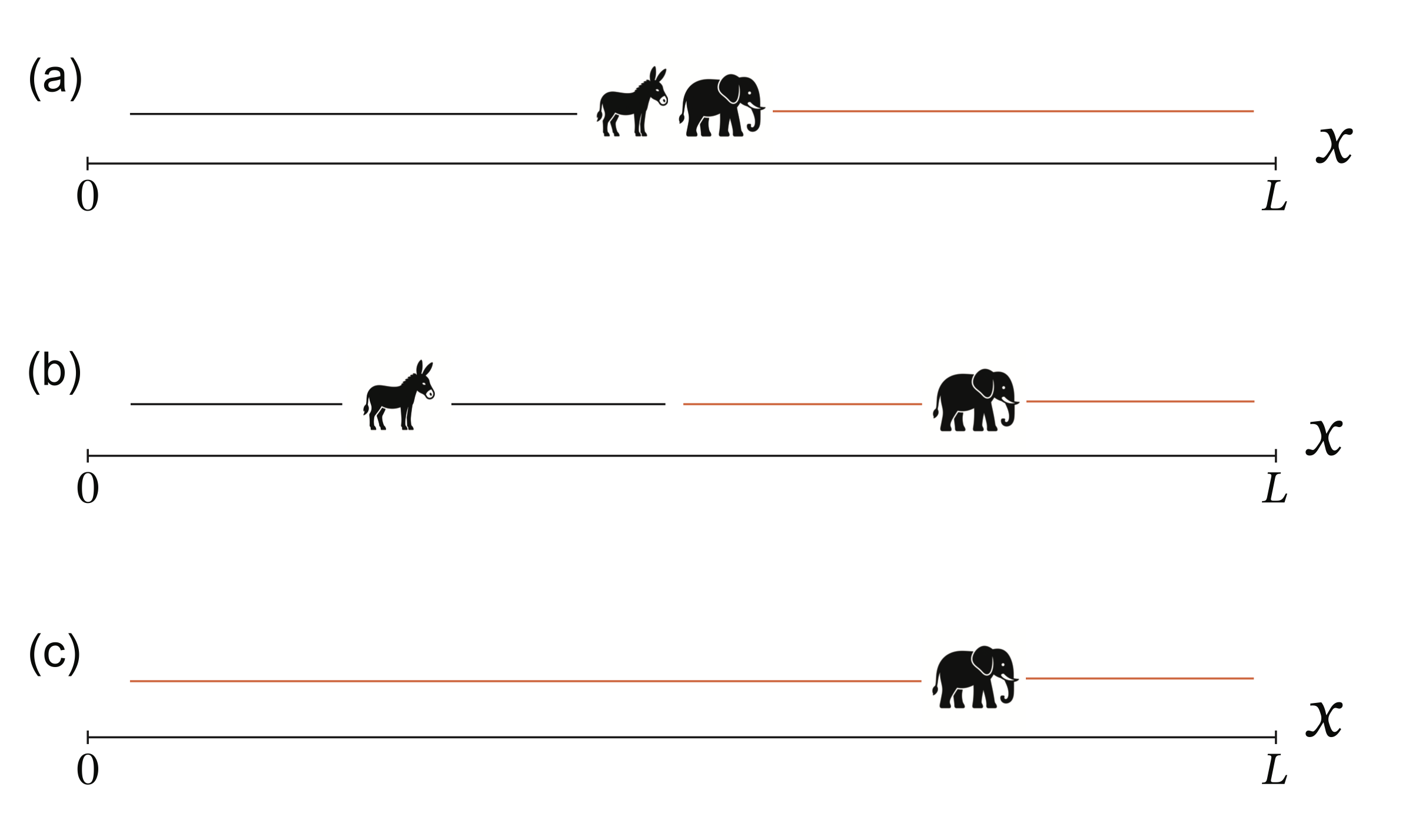
Figure 2: Optimal party positions, assuming the electorate prefers positions closer to their own. (a) Analogous to Figure 1a and 1b. (b) In primary elections, a candidate will take the median position of their party. If citizens could always live in a world dominated by their personal party, average distance would be improved here vs having a single government at the median. (c) But only one candidate can win the general election, resulting in a higher average distance than that of the median solution.
References
[1] Our model can be considered an extended Hotelling-Downs spatial model — we've made this a two-stage model to incorporate the primary process.